
Welcome Yellow Tag Students!
Advance Your Taekwon-Do Journey with Enhanced Skills
As a Yellow Tag student, you are building upon the foundational elements of Taekwon-Do. This stage focuses on refining your stances, advancing your techniques, and deepening your understanding of Taekwon-Do’s philosophical principles. The goal is to prepare you for your next significant milestone—achieving your Yellow Belt.
Key Learning Areas for Yellow Tag to Yellow Belt:
Basic Techniques:
Hand Techniques
The following will be performed in Walking stance, moving forwards or backwards
Forefist obverse middle punch, forefist reverse middle punch-(Ap joomuk baro kaunde jirugi, ap joomuk bandae kaunde jirugi)
- Description: Practice delivering a middle punch while advancing forward in a walking stance. This exercise helps develop accuracy and power in the punch, performed repeatedly as you advance.
- Practice Tips: Focus on maintaining a straight back and aligning the punch with the centerline of the body. Ensure the fist is clenched tightly at the moment of impact and rotates fully. Keep the movements fluid between each step and punch.
Outer forearm low block, outer forearm rising block – (Bakat palmok najunde makgi, bakat palmok chookyo makgi)
- Description: Practice performing low and rising blocks while moving forward in a walking stance. This drill enhances defensive techniques and coordination.
- Practice Tips: Low block should protect the lower body, particularly against kicks. Rising block should be strong enough to deflect strikes to the head.
Maintain a strong stance to ensure balance and stability.
The following will be performed in L stance, moving forwards or backwards
Inner forearm middle block – (An palmok kaunde makgi)
- Description: Practice the inner forearm middle block while advancing in an L stance. This helps in defending against middle-level attacks.
- Practice Tips: The block should align with the midsection to intercept attacks. Keep the blocking arm’s elbow slightly bent to absorb the impact. Use the hips to add power to the block.
Knifehand side strike – (Sonkal yop taerigi)
- Description: Perform the knifehand side strike while moving forward in an L stance. This technique is used to target the opponent’s neck or side of the head.
- Practice Tips: Aim to strike the opponent’s neck or side of the head.
Maintain a relaxed hand until the moment of impact.
Use a snapping motion for the strike to increase effectiveness.
Forearm guarding block – (Palmok daebi makgi)
- Description: Practice the forearm guarding block in an L stance to defend against attacks to the midsection.
- Practice Tips: Ensure the guarding hand is placed near the chest, ready to block. The blocking arm should be positioned to protect the upper body. Stay light on your feet to move quickly in response to attacks.
Knifehand guarding block – (Sonkal daebi makgi)
- Description: Practice the knifehand guarding block in an L stance, focusing on protecting against strikes to the upper body.
- Practice Tips: This block uses the knifehand to protect against strikes. Keep the knifehand strong and rigid upon impact. Maintain proper posture to ensure effective defence.
Twin forearm block – (Sang palmok makgi)
- Description: Practice the twin forearm block in an L stance to defend against simultaneous attacks from different directions.
- Practice Tips: This block defends against simultaneous attacks from different directions. Cross the arms at the chest before extending into the block. Keep the body half-facing the opponent for better defence.
Foot Techniques
The following will be performed in L stance, remain on the spot, kicking with the front leg
Downward kick (Naeryo chagi)
- Description: Practice performing a downward kick from an L stance while remaining on the spot. This kick emphasizes power and control.
- Practice Tips: Ensure a strong downward motion to maximize impact.
Keep the kicking leg straight and avoid bending the knee. Balance on the supporting leg to maintain stability.
Side turning kick (Yop dollyo chagi)
- Description: Practice the side turning kick from an L stance while remaining on the spot. This kick targets the opponent’s side.
- Practice Tips: Rotate the hips fully to generate power. Aim for the midsection or head of the opponent. Keep the hands up to guard against counter-attacks.
Side piercing kick (Yopcha jirugi)
- Description: Perform the side piercing kick from an L stance while remaining on the spot. This kick is designed to penetrate the opponent’s defence.
- Practice Tips: Use the foot sword as the striking tool. Focus on driving the kick straight into the target. Maintain a strong stance to ensure balance.
Walking stance – Front snap kick (Apcha busigi)
- Description: Kick with the back leg and step in front or kick with the front leg and step behind. This kick is fundamental for advancing in a walking stance.
- Practice Tips: Snap the kick for a quick, powerful strike. Aim for the opponent’s midsection. Keep the upper body relaxed to enhance speed.
Parallel stance – Jumping front snap kick (Twigi apcha busigi)
- Description: Perform a jumping front snap kick from a parallel stance, emphasizing height and power.
- Practice Tips: Use the jump to add height and power to the kick. Ensure proper landing to maintain balance. Practice the timing of the jump and kick for maximum effect.
To further assist you in mastering the White Belt Yellow Tag syllabus kicking techniques, we recommend watching the instructional videos available on the Irish Taekwon-Do Association’s YouTube channel. These techniques are expertly demonstrated by Master Ryan of the ITA. Click the link below to access the comprehensive video playlist and enhance your training experience:
Watch the White Belt Yellow Tag Syllabus Kicking Techniques
Exercise Patterns
Chon-Ji
Chon-Ji means “Heaven and Earth.” It symbolises the creation of the world and the beginning of human history. The pattern has 19 movements, The pattern representing the harmony between heaven and earth.
Pattern Breakdown:
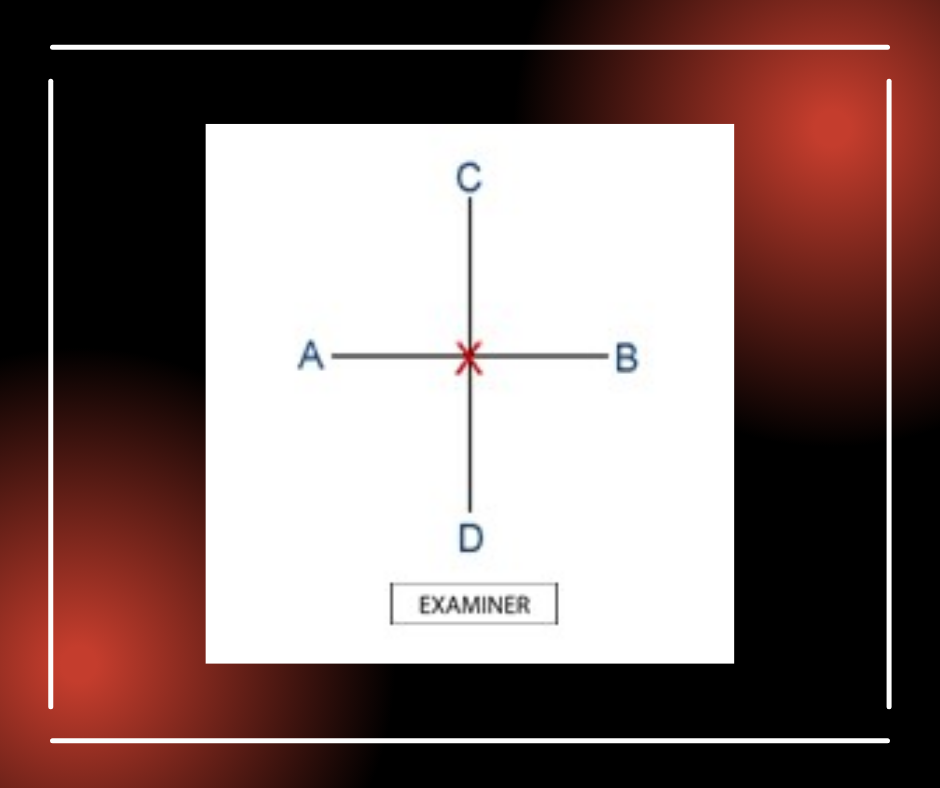
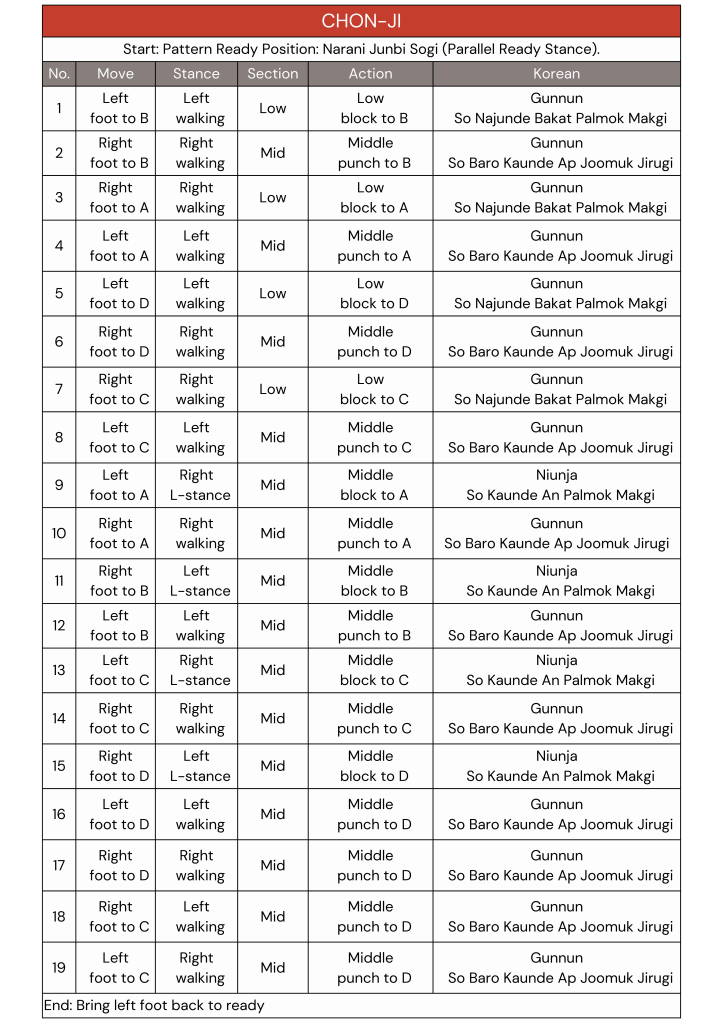
Practice Tips:
- Focus on Stances: Ensure your walking stances (gunnun sogi) are deep and strong. Your front knee should be bent so that it is directly above your heel, and your back leg should be straight. This will provide a stable base for your blocks and strikes.
- Perform Blocks Correctly: Pay attention to the height and alignment of your blocks. Low blocks (najunde makgi) should protect your lower body, while middle blocks (kaunde makgi) should be at shoulder height. Ensure your arms are properly angled to deflect attacks.
- Execute Punches with Precision: When performing middle punches (kaunde Ap jirugi), ensure your punches are aligned with your centreline and delivered with full extension. The punch should rotate sharply just before impact for maximum power.
- Maintain Balance: Balance is crucial. Make sure your weight is evenly distributed and your centre of gravity is low. This will help you maintain stability during transitions between movements.
- Use Proper Breathing: Coordinate your breathing with your movements. Inhale during preparatory movements and exhale sharply during the execution of blocks and strikes. This will help you maintain rhythm and power.
- Practice Transitions Smoothly: Work on transitioning smoothly between stances and techniques. Each movement should flow into the next without unnecessary pauses or jerky movements.
- Check Your Posture: Keep your back straight and shoulders relaxed. Avoid leaning forward or backward. Proper posture ensures better balance and effective execution of techniques.
- Train Regularly: Consistent practice is key. Dedicate time each day to go through the pattern multiple times, focusing on different aspects each session to refine your technique.
- Visualize Opponents: Imagine you are facing opponents while performing the pattern. This mental exercise can help you understand the application of each movement and improve your focus.
- Seek Feedback: Practice in front of a mirror or record yourself to check your form. Also, seek feedback from your instructor to identify areas for improvement.
Video Demonstration: Watch a step-by-step tutorial showing each movement and transition within the pattern. To further assist you in mastering the Chon-Ji , We recommend watching the instructional video below expertly demonstrated by Master Ryan available from the Irish Taekwon-Do Association.
Theory and Terminology
Theory
What is Taekwon-Do?
The scientific use of the body for attacking and defensive techniques, learned through intense physical and mental training.
What is the student oath?
- I shall observe the tenets of Taekwon-Do
- I shall respect my instructors and seniors
- I shall never misuse Taekwon-Do
- I shall be a champion of freedom and justice
- I shall build a more peaceful world
What are the sections of the body?
- High section From the top of the shoulders to the top of the head
- Middle section From the umbilicus to the top of the shoulder
- Low section All areas lower than the umbilicus
A high block is when the highest point of the blocking tool is at the same level as the eyes of the defender.
A middle block is when the highest point of the blocking tool is at the same level as the shoulder of the defender.
A low block defends against an attack aimed below the umbilicus.
Terminology
| English | Korean |
| Normal motion | Pontonguro |
| Self defence | Hosinsul |
| Power test | Wi-Ryok |
| Inward | Anuro |
| Outward | Bakuro |
| Tenet | Jungshin |
| Courtesy | Ye ui |
| Integrity | Yom chi |
| Perseverance | In nae |
| Self-control | Guk gi |
| Indomitable spirit | Baekjool bolgool |
| High section | Nopunde |
| Middle section | Kaunde |
| Low section | Najunde |
 Wexford Taekwon-Do