
Welcome White Belts!
Embark on Your Taekwon-Do Journey with Core Skills
As a White Belt, you are starting to learn the foundational elements of Taekwon-Do. This stage focuses on core stances, basic techniques, and essential philosophical principles. The goal is to prepare you for your first significant milestone—achieving your Yellow Tag.
Key Learning Areas for White to Yellow Tag:
Basic Techniques:
Hand Techniques
Parallel Stance, Forefist Middle Punch – (Narani Sogi, Kaunde Ap Joomuk Jirugi)
- Description: Perform a middle punch with a forefist while standing in a parallel stance. This technique is essential for developing both power and precision in your punches, staying stationary in a balanced stance to focus on the upper body’s movement and coordination.
- Practice Tips: Ensure both feet are parallel and shoulder-width apart. Distribute your weight evenly on both legs to maintain balance. Align the punching fist with the centreline. Tighten your fist and rotate it fully just before impact.
Sitting Stance, Forefist Middle Punch – (Annun Sogi, Kaunde Ap Joomuk Jirugi)
- Description: Execute a middle punch with a forefist while in a sitting stance. This stance emphasizes lower body strength and stability, allowing for a strong, grounded punch.
- Practice Tips: Sit deeply in your stance, ensuring your thighs are parallel to the ground and your feet are one and a half shoulder-width apart between big twos. Maintain a straight back throughout the punch. Avoid leaning forward or backward. Utilize your core muscles to add power to your punch. Tighten your abdominal muscles at the moment of impact. Look straight ahead and aim your punch at an imaginary target at mid-torso height
The following will be performed in Walking stance, moving forwards or backwards
Walking Stance, Forefist Middle Punch – (Gunnun Sogi, Baro Kaunde Ap Joomuk Jirugi)
- Description: Practice delivering a middle punch while advancing forward in a walking stance. This exercise helps develop accuracy and power in the punch, performed repeatedly as you advance.
- Practice Tips: Focus on maintaining a straight back and aligning the punch with the centreline of the body. Ensure the fist is clenched tightly at the moment of impact and rotates fully. Keep the movements fluid between each step and punch.
Walking Stance, Outer Forearm Low Block – (Gunnun Sogi, Bakat Palmok Najunde Makgi)
- Description: This exercise involves performing an outer forearm low block to protect the lower abdomen from an opponent’s attack, moving either forwards or backwards in a walking stance.
- Practice Tips: Maintain a half-facing position relative to the opponent. Keep the blocking forearm parallel to the thigh and ensure the elbow is bent outwards at about 25°. Coordinate the movement of both arms for effective blocking.
Walking Stance, Inner Forearm Middle Block – (Gunnun Sogi, An Palmok Kaunde Makgi)
- Description: Practice this defensive move to intercept attacks directed at the solar plexus and above, using the inner forearm while advancing or retreating in a walking stance.
- Practice Tips: Focus on the half-facing body position and ensure that the blocking forearm reaches the same level as the shoulders. The movement should be smooth and coordinated with the opposite arm.
Walking Stance, Outer Forearm Rising Block – (Gunnun Sogi, Bakat Palmok Chookyo Makgi)
- Description: This block is designed to protect against strikes moving down wards towards top of the head, using the outer forearm in a rising motion while in a walking stance.
- Practice Tips: Ensure that the blocking forearm is centred above the forehead at the moment of the block. The elbow should be slightly lower than the fist, creating an effective shield against the downward strike.
To further assist you in mastering the White Belt syllabus hand techniques, we recommend watching the instructional videos available on the Irish Taekwon-Do Association’s YouTube channel. These techniques are expertly demonstrated by Master Ryan of the ITA. Click the link below to access the comprehensive video playlist and enhance your training experience:
Watch the White Belt Syllabus Hand Techniques
Foot Techniques
The following will be performed in Walking stance, moving forwards or backwards
Walking Stance, Front Rising Kick – (Gunnun Sogi, Apcha Olligi)
- Description: This kick is primarily used for developing flexibility but can also be used to deflect an opponent’s attacks. Perform this kick from a walking stance, focusing on lifting the leg straight upward from the stationary position.
- Practice Tips: Concentrate on the upward motion of the kick, ensuring that the ball of the foot is used effectively. Maintain balance and control, aiming to keep the body straight and aligned throughout the kick.
Walking Stance, Outward Rising Kick – (Gunnun Sogi, Bakuro Cha Olligi)
- Description: This kick starts as a front rising kick and then transitions into an outward motion, mainly used for developing flexibility. It is performed from a walking stance with the body turning sideways as the kick reaches its apex.
- Practice Tips: Focus on the smooth transition from lifting to turning the kick outward. Ensure the body turns 90 degrees to the side as the foot comes sharply downward, maintaining balance and form.
Walking Stance, Front Snap Kick – (Gunnun Sogi, Apcha Busigi)
- Description: This kick targets the front of an opponent, ideal for hitting the solar plexus, abdomen, or lower targets. Execute this kick from a walking stance, ensuring a snapping motion with the ball of the foot.
- Practice Tips: Focus on the coordination between the lifting of the knee and the snap of the foot. The toes should be pulled back sharply as the ball of the foot strikes. Ensure that the body remains aligned and balanced, with the non-kicking foot pointing straight ahead.
The following will be performed in Parallel stance
Parallel stance, Side Piercing Kick – (Narani Sogi, Yopcha Jirugi)
- Description: A powerful kick used to attack the flank of an opponent, targeting areas such as the temple, armpit, floating ribs, or neck artery. Perform this kick from a parallel stance, using the edge of the foot or the “footsword.”
- Practice Tips: The kick should travel in a straight line with a revolving motion, maintaining the toes slightly downwards. Ensure the heel is pushed out while the toes are pulled back to tense the footsword at the moment of impact.
Parallel stance, Back Piercing Kick – (Narani Sogi, Dwitcha Jirugi)
- Description: This kick is effective for reaching targets behind you without changing body direction, using the “footsword.” It’s performed from a parallel stance and can reach long distances.
- Practice Tips: Keep the toes of the stationary foot pointed straight ahead, with the toes of the kicking foot pointed 45 degrees downward at the moment of impact. Focus on extending the kick fully to maximize reach and power.
To further assist you in mastering the White Belt syllabus kicking techniques, we recommend watching the instructional videos available on the Irish Taekwon-Do Association’s YouTube channel. These techniques are expertly demonstrated by Master Ryan of the ITA. Click the link below to access the comprehensive video playlist and enhance your training experience:
Watch the White Belt Syllabus Kicking Techniques
Exercise Patterns
Sajo Jirugi (Four Directional Punch)
Sajo Jirugi is an introductory pattern that involves executing punches in four different directions. This pattern helps you understand how to maintain balance and proper form while turning and punching.
Pattern Breakdown:
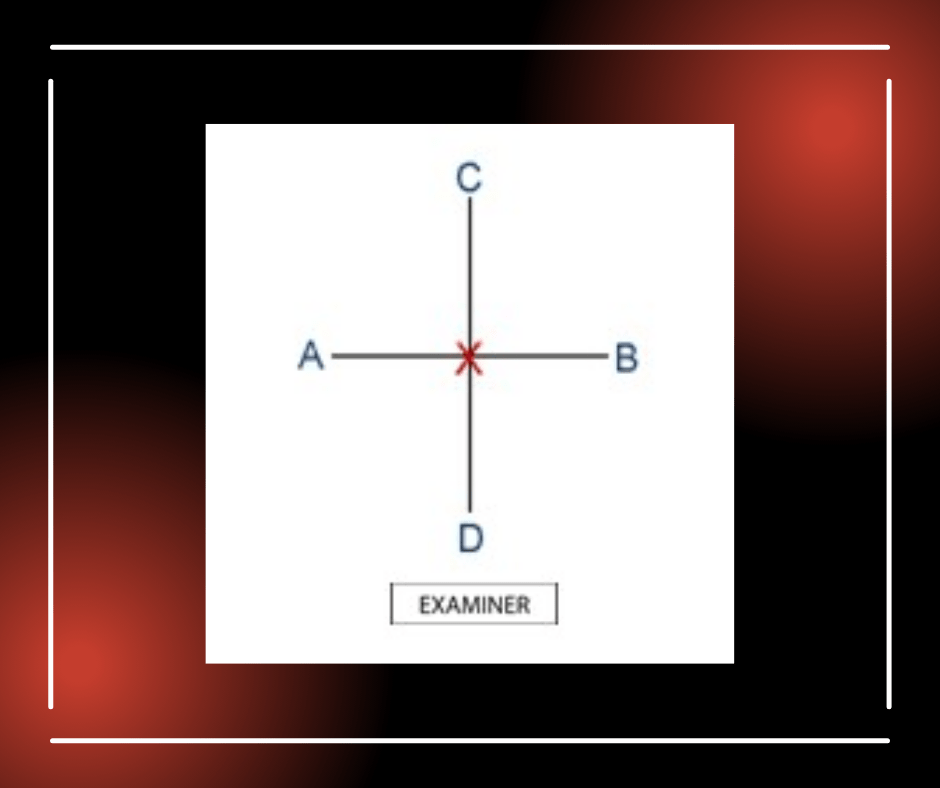
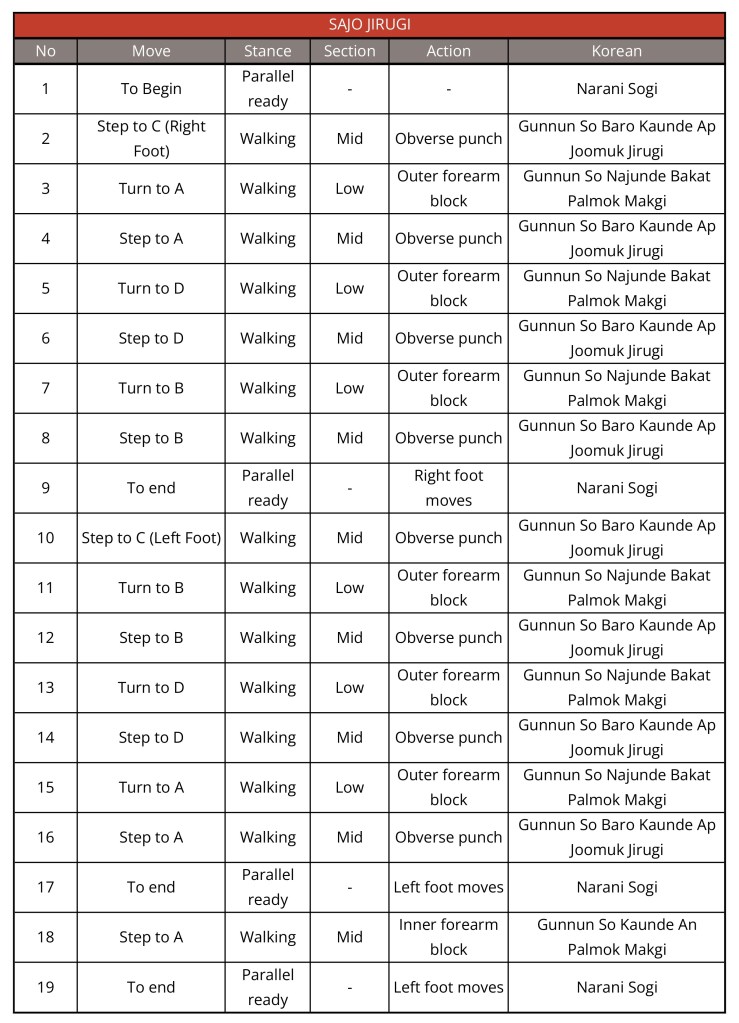
Practice Tips: Focus on the alignment of your shoulders and hips as you turn between directions. Ensure each punch is centred and strong.
Video Demonstration: Watch a step-by-step tutorial showing each movement and transition within the pattern. To further assist you in mastering the Sajo Jirugi, We recommend watching the instructional video below expertly demonstrated by Master Ryan available from the Irish Taekwon-Do Association.
Theory and Terminology
Theory
White belt meaning
White belt signifies innocence as that of a beginning student who has no previous knowledge of Taekwon-Do
What does Taekwon-Do literally mean?
The art of hand and foot. Tae means foot, kwon means hand and Do means art
Who was the father and founder of Taekwon-Do?
Grandmaster General Choi Hong Hi 9th Degree
Where does Taekwon-Do come from?
Korea
When was the name Taekwon-Do officially recognise?
April 11th 1955
What is the Korean name for the training uniform?
Dobok
What is the Korean name for the training area?
Dojang
What is a tenet?
A tenet is a belief or attitude a person should adopt while training in Taekwon-Do
What are the tenets of Taekwon-Do?
| English | Korean |
| Courtesy | Ye Ui |
| Integrity | Yom Chi |
| Perseverance | In Nae |
| Self Control | Guk Gi |
| Indomitable Spirit | Baekjool Bolgool |
For further in-depth information on the tenets Click Here
Terminology
| English | Korean |
| Obverse | Baro |
| Reverse | Bandae |
| Footsword | Balkal |
| Ball of the foot | Ap kumchi |
| Forefist | Ap joomuk |
| Knifehand | Sonkal |
| Inner forearm | An palmok |
| Outer forearm | Bakat palmok |
| High section | Nopunde |
| Middle section | Kaunde |
| Low section | Najunde |
 Wexford Taekwon-Do